Goddard & Massey Beam Engine, 1878
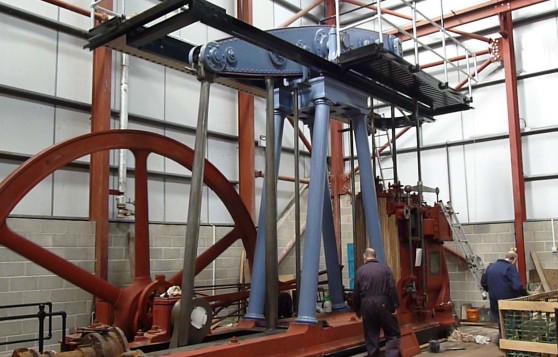
A Hornblower-Woolf compound rotative beam engine, built in 1878 by Goddard & Massey of Nottingham. It is the largest engine in the museum, with a beam of around 18 ft and a 16 ft diameter flywheel.
It was one of two engines used to pump water from the wells near Clapham Road, Bedford, which formed Bedford’s first public water supply. The engine was in use until 1959.
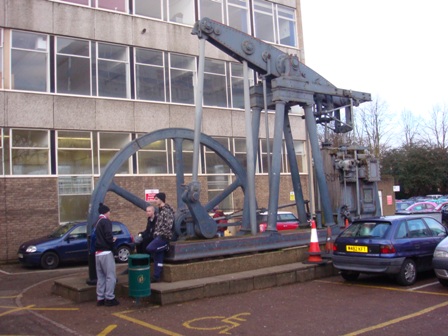
It was then dismantled, moved and re-erected at Mander College (later Bedford College) in 1965 by students and apprentices of W. H. Allen, Sons & Co. Ltd., Queens Engineering Works, Bedford, with the co-operation of the North Bedfordshire Water Board. It then stood outdoors in the college quad, unprotected, for some 45 years.
Rescue and restoration
From the time Tom Nuttall set up Markham Grange Steam Museum in the 1990s, he always expressed a desire to add a beam engine to the collection. The museum building was extended in 2006, which made room for an engine of this size.
In 2009 the Technical College in Bedford decided that the engine, which had been standing outdoors in their quad since the 1960s, could do with moving on, or going for scrap. Here was the museum’s chance, especially as nobody else seemed interested. After several working visits to Bedford to prepare the engine for transport, it was dismantled and brought to Doncaster on a low loader in August 2010, in three main pieces: the flywheel with its crankshaft, the beam, and the bedplate with cylinders and columns.
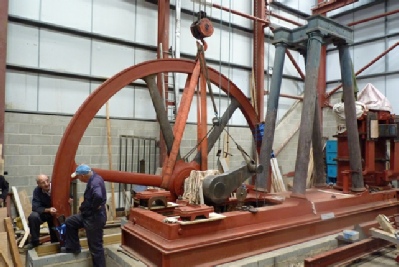
The museum volunteers then stripped the engine and carried out the restoration needed to reverse the ravages of some 45 years of English winters. The pistons had seized solid and were freed using the engine’s own connecting rod as a battering ram. New foundations were dug and concreted, the cracked bedplate was repaired, the badly corroded crankshaft journal was ground back to a true surface, and the cylinders, valve gear, beam and parallel motion were refitted. Electric motor-driven barring gear was arranged to turn the engine.
Finally, a motor-driven exhauster was connected so the engine runs by vacuum power. It now works as an “atmospheric engine”, driven by atmospheric pressure on the low pressure piston, harking back to Thomas Newcomen’s breakthrough in the early 1700s, the forerunner of the Industrial Revolution. It turns at just over 4½ rpm.
The restoration took from 2010 to 2019, with the volunteers working one to one-and-a-half days a week.
The full story, with dozens of photographs, is told year by year in the news archive: 2010, 2011, 2012, 2013, 2014, 2015, 2016, 2017 and 2018.
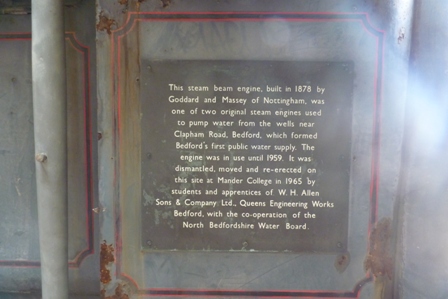
The plaque reads: “This steam beam engine, built in 1878 by Goddard and Massey of Nottingham, was one of two original steam engines used to pump water from the wells near Clapham Road, Bedford, which formed Bedford’s first public water supply. The engine was in use until 1959. It was dismantled, moved and re-erected on this site at Mander College in 1965 by students and apprentices of W. H. Allen Sons & Company Ltd., Queens Engineering Works, Bedford, with the co-operation of the North Bedfordshire Water Board.”
Technical details
| Type of Engine | Hornblower-Woolf compound rotative beam engine |
|---|---|
| Builder & Year | Goddard & Massey, Nottingham; 1878 |
| Original use | Pumping water from the wells near Clapham Road, Bedford, for the town’s first public water supply (in use until 1959) |
| Beam | Around 18 ft long |
| Flywheel | 16 ft diameter |
| Cylinder Sizes | High Pressure (HP) piston 19.5 ins. diameter |
| Valves | Slide valves on the HP and LP cylinders, with a steam cut-off cam |
| Running today | By vacuum, with electric motor-driven barring gear to start it, using an ESAM “Unijet” 500 exhauster with a 7.5 kW electric motor, at just over 4½ rpm |
Find out more
Video: the initial trial running of the engine, soon after restoration.
The booklet Homing In On The Beam explains the engine in detail, including its recovery from Bedford and restoration. It is on sale in the museum for £2.50 (see the shop).